
Picture this: you’re stuck in bumper-to-bumper traffic on a scorching summer day when a small red icon — shaped like a thermometer submerged in liquid — suddenly lights up on your dashboard. Within minutes, steam starts curling from under your hood.
This is not a drill. The red thermometer light on dashboard is arguably the most urgent warning your vehicle can display. It means your engine’s coolant temperature has climbed to a dangerously high level — and continuing to drive even a few minutes longer can cause thousands of dollars in permanent engine damage.
According to engine repair industry data, overheating is responsible for an estimated 27% of all major engine failures in passenger vehicles. Yet many drivers don’t know what the thermometer symbol means — or what to do when it appears.
In this guide from CarCostGuide.com, you’ll learn exactly what triggers this warning, the immediate steps that can save your engine, and the real repair costs involved.
💡 Not sure which warning light you’re looking at? Our [complete dashboard warning lights guide] identifies every symbol on your instrument cluster with clear photos and explanations.
What Does the Red Thermometer Light on Dashboard Mean?
The red thermometer light on your dashboard is the engine coolant temperature warning indicator. It activates when the engine’s internal temperature exceeds the safe operating range — typically above 230°F (110°C), though the exact threshold varies by manufacturer.
Your engine’s cooling system circulates coolant (a mixture of antifreeze and water) through the engine block, absorbing heat and dissipating it through the radiator. When this system fails or can’t keep up with heat production, temperatures spike rapidly — and the thermometer light is your last line of defense before catastrophic damage occurs.
| Light Color | Meaning | Action Required |
|---|---|---|
| Blue thermometer | Engine is cold — normal at startup | Drive gently until it turns off |
| No light displayed | Engine at normal operating temperature | No action needed |
| Red thermometer (steady) | Engine overheating — danger | Pull over immediately |
| Red thermometer (flashing) | Critical overheating — imminent damage | Stop engine NOW |
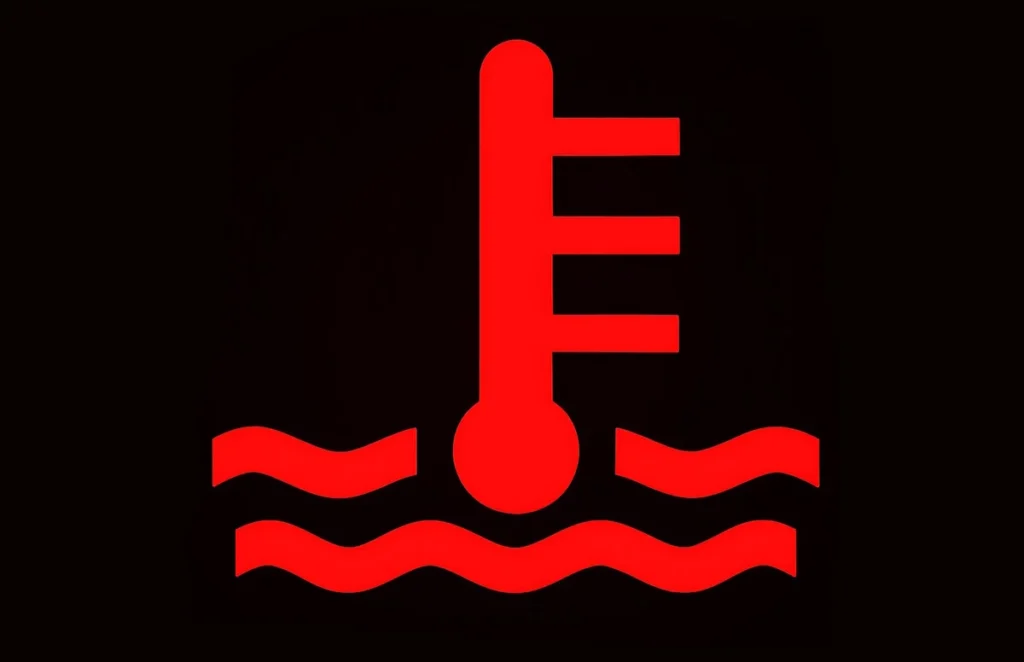
Why the Red Thermometer Light Is the Most Dangerous Dashboard Warning
Most dashboard warnings give you a grace period. Low tire pressure? You have days. Check engine light? Usually weeks. But the red thermometer light on dashboard operates on a timeline measured in minutes — sometimes seconds.
Here’s what happens inside your engine when it overheats:
The Damage Timeline
- 230–240°F — Warning light activates. Coolant begins boiling in hotspots.
- 240–260°F — Head gasket begins to weaken. Engine oil starts breaking down.
- 260–280°F — Head gasket failure likely. Cylinder head warping begins.
- 280°F+ — Pistons can seize. Bearings fail. Engine block may crack.
According to the American Automobile Association (AAA), engine overheating is among the top five reasons for emergency roadside assistance calls during summer months.
The bottom line: A $15 thermostat ignored today becomes a $3,000–$7,000 engine replacement tomorrow. No other dashboard light carries this level of financial risk in such a short timeframe.
📸 [Image #2] — Engine damage progression infographic showing temperature stages
6 Common Causes of the Red Thermometer Light
Understanding what triggers the engine temperature warning light helps you diagnose the problem faster and communicate more effectively with your mechanic.
1. Low Coolant Level
This is the most frequent cause — and often the easiest to fix. Coolant levels drop over time due to small evaporation, minor seepage at hose connections, or undetected slow leaks. When coolant drops below the minimum level, there isn’t enough fluid to absorb engine heat.
Quick check: Locate the coolant reservoir under the hood (usually a translucent plastic tank marked with MIN/MAX lines). If the level is below MIN, add a 50/50 coolant/water mixture after the engine cools.
⚠️ Never open the radiator cap on a hot engine. Pressurized coolant can erupt at 250°F+ and cause severe burns.
2. Failed Thermostat
The thermostat acts as a valve between the engine and radiator. When working properly, it opens at around 195–220°F to allow coolant to flow through the radiator for cooling. A stuck-closed thermostat traps hot coolant inside the engine, causing temperatures to skyrocket.
Common symptom: Temperature gauge rises quickly after startup and the upper radiator hose stays cold (meaning coolant isn’t flowing).
Repair cost: $150–$350
3. Broken or Leaking Radiator
Radiators develop leaks from corrosion, road debris impacts, and age-related fatigue. Even a small pinhole leak reduces cooling system pressure and allows coolant to escape gradually. A severely damaged radiator can’t dissipate heat effectively even when full.
💡 CTA: Wondering what radiator replacement costs for your vehicle? Browse our [radiator repair cost guide by make and model] for accurate estimates.
4. Failed Water Pump
The water pump circulates coolant throughout the entire cooling system. When its impeller breaks, bearings seize, or the shaft seal leaks, coolant circulation slows or stops completely — and temperatures climb fast.
Warning signs:
- Coolant leak from the front of the engine
- Whining or grinding noise from the water pump area
- Steam from under the hood
- Visible coolant weeping around the pump housing
Repair cost: $300–$800
5. Blown Head Gasket
A blown head gasket allows coolant to leak into the combustion chambers or oil passages. This causes coolant loss without visible external leaks — making it tricky to diagnose. The engine overheats because coolant is being consumed internally.
Telltale signs:
- White smoke (steam) from the exhaust
- Milky, chocolate-colored oil on the dipstick
- Coolant loss with no visible leak
- Bubbles in the coolant reservoir while running
Repair cost: $1,000–$3,000
6. Faulty Cooling Fan or Fan Relay
Your radiator fan pulls air through the radiator when the vehicle is moving slowly or idling. If the fan motor burns out, the fan relay fails, or a fuse blows, the radiator can’t dissipate heat at low speeds.
Key clue: Overheating occurs only in traffic or at idle but the temperature drops back to normal at highway speed.
Repair cost: $150–$500
📸 [Image #3] — Infographic showing all 6 causes with icons and severity ratings
What to Do Immediately When the Red Thermometer Light Comes On
When the red thermometer light on dashboard activates, every second counts. Follow these steps immediately:
- Turn off the air conditioning. The A/C compressor adds significant load and heat to the engine.
- Turn the heater to maximum heat and fan speed. This sounds counterintuitive, but the heater core acts as a secondary radiator — pulling heat away from the engine and into the cabin.
- Pull over safely as soon as possible. Do not drive more than 1–2 minutes with the light on.
- Put the transmission in Park/Neutral and let the engine idle for 30–60 seconds before shutting off — this allows the water pump to continue circulating coolant briefly. (Skip this step if steam is visible or the gauge is in the red zone — shut off immediately.)
- Turn off the engine.
- Wait at least 30 minutes before opening the hood. Do NOT touch the radiator cap until the engine is fully cool.
- Check coolant level once cooled. Add coolant if available. If the reservoir is bone dry, do not restart — call for a tow.
- Call roadside assistance if you can’t identify and fix the cause on the spot.
📸 [Image #4] — Emergency response steps infographic
⚠️ Critical rule: If the temperature gauge enters the red zone and you see steam, do NOT keep driving to “make it to the shop.” An extra 5 minutes of driving can turn a $300 thermostat replacement into a $5,000 engine rebuild.
How to Diagnose Engine Overheating Problems
Once the engine has cooled completely, these diagnostic steps help identify the root cause:
Visual Inspection
- Check coolant level in the reservoir and radiator (when cold)
- Look for leaks — puddles under the car, wet spots on hoses, stains around the water pump and radiator
- Inspect radiator hoses — squeeze them. Soft, mushy, cracked, or swollen hoses need replacement
- Check the radiator for visible damage, bent fins, or debris blockage
- Examine the serpentine belt — if it’s broken, the water pump isn’t spinning
Temperature Gauge Behavior Clues
| Behavior | Likely Cause |
|---|---|
| Gauge rises quickly after startup | Stuck thermostat or very low coolant |
| Overheats only in traffic/at idle | Cooling fan failure |
| Overheats only at highway speed | Radiator blockage or collapsed hose |
| Gauge fluctuates up and down | Air pocket in cooling system or failing thermostat |
| Slow, gradual overheating over weeks | Slow coolant leak or partially clogged radiator |
Advanced Diagnostics
For persistent overheating problems, these tests provide definitive answers:
- Cooling system pressure test — reveals hidden leaks ($30–$60 tool or free at many shops)
- Combustion gas test (block test) — detects head gasket failure by checking for exhaust gases in the coolant
- Infrared thermometer scan — identifies cold spots in the radiator indicating internal blockage
💡 CTA: Need help estimating repair costs before visiting a shop? Use our [engine cooling system repair cost calculator] for instant pricing by vehicle.
📸 [Image #5] — Diagnostic flowchart for engine overheating
Repair Costs for Engine Overheating Issues
| Problem | DIY Cost | Mechanic Cost |
|---|---|---|
| Coolant top-off | $5–$15 | $10–$30 |
| Coolant system flush | $20–$40 | $100–$200 |
| Thermostat replacement | $15–$40 | $150–$350 |
| Radiator hose replacement | $15–$40 | $75–$200 |
| Cooling fan motor replacement | $80–$200 | $200–$500 |
| Fan relay or fuse replacement | $5–$30 | $20–$75 |
| Water pump replacement | $50–$200 | $300–$800 |
| Radiator replacement | $100–$350 | $300–$900 |
| Head gasket repair | N/A (advanced) | $1,000–$3,000 |
| Engine replacement | N/A | $3,000–$7,000+ |
The math is clear: Every component on this list is dramatically cheaper to fix than the engine damage it prevents when ignored. A $25 thermostat protects a $5,000 engine.
📸 [Image #6] — Cost comparison chart graphic
How to Prevent Engine Overheating
These straightforward maintenance habits keep the red thermometer light on dashboard from ever appearing:
- Check coolant level monthly. It takes 30 seconds and catches slow leaks early.
- Flush and replace coolant every 30,000 miles (or per your manufacturer’s schedule). Old coolant loses its corrosion inhibitors and heat transfer properties.
- Inspect radiator hoses every oil change. Squeeze them — replace any that feel soft, spongy, or show cracks.
- Keep the radiator clean. Blast debris from the front of the radiator with a garden hose every spring. Bugs, leaves, and road grime block airflow.
- Replace the thermostat proactively around 100,000 miles — it’s cheap insurance.
- Watch your temperature gauge habitually. Notice the normal operating position and investigate immediately if it starts creeping higher than usual.
- Never use plain water as coolant long-term. Water boils at 212°F. A proper 50/50 coolant mix raises the boiling point to roughly 265°F under pressure — giving you a much larger safety margin.
- Replace the water pump with the timing belt (on interference engines). Both are accessed together, saving significant labor costs.
Frequently Asked Questions
What does the red thermometer light mean on my dashboard?
The red thermometer light means your engine coolant temperature has risen to a dangerously high level. Your engine is overheating. This is one of the most urgent dashboard warnings. Pull over safely, turn off the engine, and let it cool before investigating. Common causes include low coolant, a failed thermostat, or a broken water pump.
Can I drive with the red temperature light on?
No — stop driving as soon as safely possible. Continuing to drive with the red thermometer light on risks catastrophic engine damage including warped cylinder heads, blown head gaskets, and seized pistons. Even 2–5 minutes of additional driving at extreme temperatures can cause thousands of dollars in irreversible damage.
Why is my car overheating but the coolant is full?
If coolant level appears normal but the engine overheats, the problem is likely a stuck thermostat, failed water pump, blocked radiator, or non-functioning cooling fan. These components can fail while the coolant level remains adequate. A stuck thermostat is the most common cause — it prevents coolant from circulating even when the reservoir is full.
What’s the difference between the blue and red thermometer light?
The blue thermometer light indicates your engine is still cold — below normal operating temperature. This is completely normal at startup and typically turns off within 1–5 minutes. The red thermometer light means the engine is overheating — dangerously above normal temperature. Blue means patience. Red means emergency.
How much does it cost to fix an overheating car?
Costs range from $5 (coolant top-off) to $7,000+ (engine replacement) depending on the root cause. The most common fixes — thermostat and coolant flush — cost between $100 and $350. Water pump and radiator replacements range from $300–$900. Head gasket repair typically costs $1,000–$3,000.
Can low oil cause the temperature light to come on?
Indirectly, yes. Engine oil serves as a secondary coolant, carrying roughly 40% of engine heat away from critical components. Severely low oil increases friction and heat generation, which can push coolant temperatures above the warning threshold. Always maintain proper oil levels alongside coolant levels.
Is the thermometer light the same as the check engine light?
No — they are entirely different warnings. The thermometer light specifically monitors engine coolant temperature and indicates overheating. The check engine light monitors engine performance, emissions, and sensor systems. The thermometer light demands immediate action; the check engine light typically allows more time for diagnosis.
How long should I wait before opening the hood after overheating?
Wait a minimum of 30 minutes — ideally 45–60 minutes. Coolant in an overheated engine can be 250°F+ and pressurized. Opening the radiator cap too early can cause boiling coolant to erupt violently, causing severe burns. The engine and cooling system must be fully depressurized before any inspection.
Final Thoughts
The red thermometer light on dashboard is your engine’s emergency alarm — and it deserves the same urgency you’d give a smoke detector in your home. Unlike most dashboard warnings that give you days or weeks to respond, an overheating engine operates on a countdown measured in minutes.
Key takeaways to remember:
- The red thermometer means your engine is overheating — pull over and stop driving immediately. No exceptions.
- Low coolant is the most common cause and often the cheapest fix. Check your coolant level monthly to catch problems early.
- A stuck thermostat is the most common mechanical failure — it’s a $150–$350 repair that prevents $3,000–$7,000 in engine damage.
- Never open the radiator cap on a hot engine. Wait at least 30 minutes for the system to cool and depressurize.
- Turn your heater to maximum when the light first appears — this buys precious time by using the heater core as an emergency radiator.
Your engine is the most expensive single component in your vehicle. The red thermometer light on dashboard gives you a brief window to protect it. Respect that window, act fast, and you’ll save yourself thousands.
Has your temperature light ever turned red at the worst possible moment? What caused it? Share your story in the comments below — your experience could help another driver avoid a catastrophic breakdown. For more trusted repair guides and cost breakdowns, explore CarCostGuide.com.