
You’re merging onto the highway in your Volkswagen when the engine suddenly loses power. Your foot is on the gas, but the car barely responds. Then you see it — three bold letters illuminated on your dashboard: EPC.
If this scenario sounds familiar, you’re far from alone. The EPC light Volkswagen warning is one of the most frequently reported — and most misunderstood — dashboard alerts across the entire VW lineup. From Jettas to Tiguans, Golfs to Passats, this warning affects every model and generation.
Unlike many dashboard lights that simply monitor one system, the EPC light can indicate problems ranging from a $5 gas cap issue to a $2,000 throttle body replacement. The cause determines the cost — and the urgency. In this detailed guide from CarCostGuide.com, you’ll learn exactly what activates the EPC warning, how to diagnose it, and the most effective fixes for every common trigger.
💡 Dealing with multiple VW dashboard warnings? Our [complete dashboard warning lights guide] explains every Volkswagen indicator with clear photos and descriptions.
What Does the EPC Light Mean on a Volkswagen?
The EPC light stands for Electronic Power Control (Elektronische Leistungskontrolle in German). It indicates a fault within your Volkswagen’s electronic throttle control system — the drive-by-wire system that translates your accelerator pedal input into engine throttle response.
In modern Volkswagens, there is no physical cable connecting your gas pedal to the throttle body. Instead, electronic sensors on the pedal send signals to the engine control module (ECM), which commands the electronic throttle body to open or close accordingly. When any component in this chain malfunctions, the EPC warning activates.
In many cases, the EPC light triggers limp mode — dramatically reducing engine power to protect the drivetrain from further damage.
| EPC Light Behavior | What It Means | Severity |
|---|---|---|
| EPC light steady, normal power | Minor sensor or electrical glitch | Low to Moderate |
| EPC light + reduced engine power | Throttle system fault, limp mode active | Moderate to High |
| EPC + check engine light together | Engine/emission sensor triggering EPC | Moderate to High |
| EPC + flashing check engine light | Active misfire affecting throttle control | High — stop driving |
| EPC light at startup, then goes off | System self-check (normal) or intermittent fault | Low |
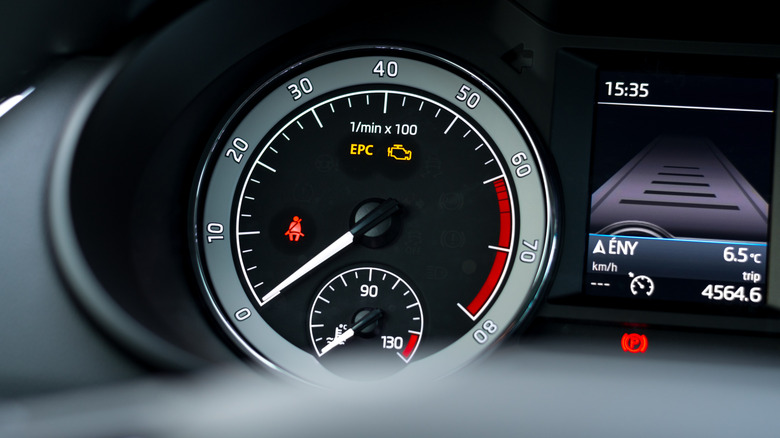
How the EPC System Works in Volkswagen Vehicles
Understanding the electronic throttle system helps you troubleshoot the EPC light more effectively.
Key EPC System Components
Your Volkswagen’s electronic power control relies on five core components:
- Accelerator pedal position sensor (APP) — detects how far you press the gas pedal (two redundant sensors for safety)
- Electronic throttle body — motorized valve that controls airflow into the engine
- Throttle position sensor (TPS) — confirms the throttle body’s actual position
- Engine control module (ECM) — the computer that processes all sensor data and commands the throttle
- Wiring harnesses and connectors — electrical pathways connecting everything
When you press the gas pedal, the APP sensor sends a voltage signal to the ECM. The ECM then commands the throttle body motor to open proportionally. The TPS confirms the throttle actually moved to the correct position. If any mismatch or fault occurs anywhere in this loop, the EPC light activates.
📸 [Image #2] — Diagram showing EPC system components in a Volkswagen
8 Common Causes of the EPC Light on Volkswagen
Here are the most frequent triggers for the EPC light Volkswagen warning, based on VW Technical Service Bulletins, repair shop records, and owner community reports.
1. Faulty Throttle Body
The electronic throttle body is the most common cause of EPC light activation across all VW models. Carbon buildup restricts the throttle plate movement, and the internal motor or position sensor can fail with age.
Especially common on: 2.0T TSI and 2.5L five-cylinder engines
Symptoms alongside EPC:
- Significant power loss or limp mode
- Rough or hunting idle
- Engine surging at steady throttle
- Delayed throttle response
Common DTC codes: P2111, P2112, P2135, P0638
Repair cost: $200–$600
2. Bad Accelerator Pedal Position Sensor
The APP sensor sends your throttle input to the ECM. When it fails, sends erratic signals, or has corroded connectors, the ECM can’t determine how much throttle you’re requesting — triggering the EPC light and often limp mode.
Common DTC codes: P2122, P2123, P2127, P2128, P2138
Repair cost: $100–$300
💡 CTA: Wondering about specific repair pricing for your VW model? Check our [Volkswagen repair cost guide] for model-by-model estimates.
3. Brake Light Switch Failure
This is a VW-specific quirk that catches many owners off guard. Volkswagen’s ECM uses the brake light switch signal as part of the throttle control logic — particularly for cruise control interaction and idle management. When the brake light switch fails, the EPC light activates.
Telltale signs:
- Brake lights stay on constantly or don’t illuminate at all
- Cruise control stops working
- EPC light appears alongside brake-related symptoms
- Car won’t shift out of Park easily (on automatics)
Common on: Jetta, Golf, Passat, Beetle (2005–2018)
Repair cost: $15–$50 (one of the cheapest EPC fixes)
4. Mass Air Flow (MAF) Sensor Issues
The MAF sensor measures incoming air volume. When it fails or becomes contaminated, the ECM receives incorrect air data, which disrupts the air-fuel ratio and can trigger the EPC light alongside the check engine light.
Common DTC codes: P0100, P0101, P0102, P0103
Quick tip: Before replacing the MAF sensor, try cleaning it with dedicated MAF cleaner spray. This $8 fix resolves the problem roughly 40–50% of the time.
5. Coil Pack or Spark Plug Failure
Engine misfires caused by failing ignition coils or worn spark plugs can trigger the EPC warning. VW’s ECM monitors engine torque output — when misfires create erratic torque, the system flags it as a power control issue.
Especially common on: 1.8T, 2.0T TSI/TFSI engines
Common DTC codes: P0300–P0304 (misfire codes), P0351–P0354 (coil codes)
Repair cost: $50–$200 (plugs + coils DIY); $150–$450 (at a shop)
6. Vacuum Leak
Unmetered air entering the engine through cracked vacuum hoses, intake manifold gasket failures, or PCV system leaks causes lean-running conditions that the ECM interprets as a throttle control problem.
Common leak locations on VW:
- PCV valve and associated hoses
- Intake manifold gasket
- Brake booster vacuum line
- Diverter valve (on turbo models)
7. Wiring or Connector Corrosion
Corroded ground wires, damaged wiring harnesses, and oxidized sensor connectors are particularly common on Volkswagens driven in salt-belt regions. Even minor corrosion on the throttle body or APP sensor connector can cause intermittent EPC warnings.
Diagnostic clue: The EPC light appears randomly, often in wet or humid conditions, and may clear itself temporarily.
8. ABS or Steering Angle Sensor Fault
On some VW models, the EPC system integrates data from the ABS module and steering angle sensor for traction and stability management. Faulty wheel speed sensors or a miscalibrated steering angle sensor can trigger the EPC light — especially alongside the ABS or traction control warnings.
Common after: Battery replacement, wheel alignment, or ABS repair
📸 [Image #3] — Infographic showing all 8 causes with severity indicators
Is It Safe to Drive With the EPC Light On?
It depends on the symptoms — but in most cases, you should get to a repair facility soon.
When You Can Drive Carefully
If the EPC light is on but your car drives completely normally with no power loss:
- You can likely drive to a nearby shop or home
- The cause may be a minor sensor issue or brake light switch
- Monitor for any change in performance
When You Should Stop Driving
Pull over safely if you experience:
- Limp mode (engine severely limited, won’t exceed 25–35 mph)
- EPC + flashing check engine light (active misfire — catalytic converter risk)
- Complete loss of throttle response
- EPC + overheating (potential coolant-related electrical issue)
- Stalling or engine shutting off unexpectedly
| Scenario | Safe to Drive? | Action |
|---|---|---|
| EPC only, no symptoms | Yes, short distance | Schedule diagnostic within days |
| EPC + mild power loss | Cautiously to a shop | Get scanned ASAP |
| EPC + limp mode | Minimal distance only | Drive to nearest safe location |
| EPC + flashing CEL | No | Pull over immediately |
| EPC + stalling | No | Call roadside assistance |
⚠️ Driving in limp mode for extended distances can cause additional stress on transmission components and catalytic converters. Minimize your driving until the issue is resolved.
How to Fix and Reset the EPC Light on Volkswagen
Based on the specific cause, here are the most effective fixes for the EPC light Volkswagen owners encounter.
Fix 1: Check and Replace the Brake Light Switch
- Press the brake pedal and have someone confirm whether your brake lights illuminate.
- If they don’t — or if they stay on permanently — the brake light switch has likely failed.
- Locate the switch above the brake pedal (it clips onto the brake pedal bracket).
- Remove the old switch by twisting it 90 degrees and pulling.
- Install the new switch and test brake light function.
- Clear codes with a scanner and test drive.
Time required: 10–15 minutes
Cost: $10–$30 for the part
Fix 2: Clean or Replace the Throttle Body
- Remove the air intake hose from the throttle body.
- Spray throttle body cleaner onto the butterfly valve and bore. Wipe clean with a lint-free cloth.
- Do NOT force the butterfly open manually on electronic throttle bodies — this can damage the motor.
- Reinstall and reconnect everything.
- Perform a throttle body adaptation reset using VCDS/OBDeleven (essential on VW vehicles).
Important: Volkswagen throttle bodies typically require a software adaptation procedure after cleaning or replacement. Without this step, the ECM won’t recognize the new baseline and the EPC light will persist.
Fix 3: Replace the Accelerator Pedal Sensor
- Disconnect the battery.
- Locate the APP sensor assembly at the top of the accelerator pedal.
- Disconnect the electrical connector.
- Remove the mounting bolts (usually 2–3).
- Install the new sensor assembly.
- Reconnect the battery and clear codes.
Fix 4: Replace Spark Plugs and Coil Packs
Use OEM or OEM-equivalent spark plugs and coil packs. For most VW engines:
- Spark plugs: NGK or Bosch (match the OEM part number)
- Coil packs: Bosch or Eldor (OEM suppliers for VW)
Fix 5: Reset the EPC Light
After completing any repair, reset using one of these methods:
Method A — VCDS/OBDeleven (Recommended for VW):
- Connect VCDS or OBDeleven to the OBD-II port.
- Access the Engine Control Module (01).
- Select “Clear Fault Codes.”
- Perform throttle body adaptation (Basic Settings → Group 060 on many models).
- Restart the engine and confirm the light stays off.
Method B — Battery Disconnect:
- Disconnect negative terminal for 20 minutes.
- Reconnect and start the engine.
- Let it idle for 5 minutes to allow ECM relearning.
Method C — Ignition Cycle:
- Turn ignition ON (don’t start) for 10 seconds.
- Turn OFF for 10 seconds.
- Repeat 3 times, then start the engine.
📸 [Image #4] — Step-by-step EPC reset methods infographic
💡 CTA: Need a VW-specific diagnostic tool? Our [best OBD-II scanners for Volkswagen guide] compares the top options for every budget.
How to Diagnose EPC Light Problems
Follow this diagnostic sequence to identify the root cause efficiently.
Step 1: Check the Obvious First
- Brake lights working? Press the pedal and have someone look. This eliminates the cheapest fix instantly.
- Gas cap tight? On some models, a loose gas cap triggers the EPC light alongside the check engine light.
- Any recent work done? Battery replacement, alignment, or brake service can trigger sensor recalibration needs.
Step 2: Scan with a VW-Compatible Tool
Standard generic OBD-II scanners read engine codes only. For comprehensive VW diagnostics, you need a tool that accesses all control modules — including the throttle body, ABS, steering, and transmission modules.
Recommended VW diagnostic tools:
- VCDS (VAG-COM) — the gold standard for VW/Audi diagnostics ($199–$349)
- OBDeleven — smartphone-based, excellent for VW ($60–$160)
- iCarsoft VAWS V2.0 — dedicated VW/Audi scanner (~$170)
- Foxwell NT510 Elite — multi-brand with strong VW coverage (~$160)
Step 3: Interpret the Codes
Common EPC-related code categories:
| Code Range | System | Example Causes |
|---|---|---|
| P2100–P2140 | Throttle body/actuator | Carbon buildup, motor failure, TPS fault |
| P2120–P2140 | Accelerator pedal sensor | APP sensor failure, wiring issue |
| P0100–P0104 | Mass air flow sensor | Contaminated or failed MAF |
| P0300–P0306 | Engine misfires | Spark plugs, coil packs, injectors |
| P0171, P0174 | Lean condition | Vacuum leaks, fuel delivery issues |
Step 4: Visual Inspection
- Throttle body — look for heavy carbon deposits around the butterfly valve
- Wiring harnesses — check for chafing, cracked insulation, or corroded pins
- Vacuum hoses — look for cracks, disconnections, or collapsed lines
- Brake light switch — verify physical condition and secure mounting
📸 [Image #5] — Diagnostic flowchart for EPC light troubleshooting
EPC Light Repair Costs by Cause
| Problem | DIY Cost | Mechanic Cost |
|---|---|---|
| Brake light switch replacement | $10–$30 | $30–$80 |
| Throttle body cleaning | $8–$15 | $80–$150 |
| Throttle body replacement | $150–$350 | $300–$600 |
| Accelerator pedal sensor replacement | $50–$150 | $100–$300 |
| MAF sensor cleaning | $8 | $40–$80 |
| MAF sensor replacement | $40–$120 | $100–$250 |
| Spark plugs + coil packs | $50–$200 | $150–$450 |
| Vacuum leak repair | $5–$30 | $75–$250 |
| Wiring/connector repair | $10–$40 | $75–$300 |
| ABS wheel speed sensor | $25–$80 | $100–$300 |
| Full EPC diagnostic scan | Free–$100 | $80–$175 |
Money-saving tip: The brake light switch is the single cheapest EPC fix — and it’s one of the most common causes. Always check it before authorizing expensive throttle body work.
📸 [Image #6] — Cost comparison chart
How to Prevent EPC Light Issues
These maintenance habits keep the EPC light Volkswagen drivers dread from appearing:
- Clean the throttle body every 40,000–60,000 miles. Carbon buildup is the leading cause of EPC issues. A 20-minute cleaning prevents the most common trigger.
- Replace spark plugs on schedule. VW recommends every 40,000–60,000 miles for turbocharged engines and up to 80,000 miles for naturally aspirated models.
- Inspect vacuum hoses during oil changes. Cracked or brittle hoses are easy to spot and cheap to replace proactively.
- Use quality fuel. Top-tier gasoline with better detergent additives keeps fuel injectors and intake components cleaner. VW engines — especially direct-injection TSI models — benefit significantly from high-quality fuel.
- Replace the brake light switch proactively around 100,000 miles — especially on Jetta, Golf, and Passat models where failure is common.
- Keep your battery healthy. Voltage fluctuations confuse VW’s sensitive electronic modules. Test annually after year three and replace every 4–5 years.
- Invest in VCDS or OBDeleven. For VW owners, these tools pay for themselves after a single diagnostic session. Catching faults early saves hundreds in repair costs.
- Address intermittent EPC warnings immediately. A warning that appears and disappears signals a worsening problem — never a resolved one.
Frequently Asked Questions
What does EPC mean on a Volkswagen?
EPC stands for Electronic Power Control — Volkswagen’s electronic throttle control system. When the EPC light activates, it means the system has detected a fault in the components that control how your engine responds to throttle input. Common causes include a faulty throttle body, bad accelerator pedal sensor, failed brake light switch, or engine misfires.
Can I drive my VW with the EPC light on?
If your car drives normally with no power loss, you can carefully drive to a repair shop. However, if the EPC light triggers limp mode (severely reduced power), drive only far enough to reach a safe location. Never drive extended distances with a flashing check engine light alongside the EPC warning — this indicates active misfires that can damage the catalytic converter.
How do I reset the EPC light on my Volkswagen?
First, fix the underlying problem. Then use VCDS or OBDeleven to clear fault codes and perform a throttle body adaptation. Alternatively, disconnect the negative battery terminal for 20 minutes, then reconnect and idle for 5 minutes. On some models, cycling the ignition ON/OFF three times can also trigger a reset. Always address the root cause before resetting.
Why do the EPC and check engine light come on together?
The EPC and check engine lights frequently appear together because engine performance directly affects throttle control. Misfires, MAF sensor failures, vacuum leaks, and fuel system faults trigger the check engine light while simultaneously disrupting the torque data the EPC system monitors. Fixing the engine-side issue typically resolves both warnings.
Can a bad battery cause the EPC light on a Volkswagen?
Yes. Volkswagen’s electronic modules are highly sensitive to voltage. A weak or dying battery causes voltage drops that disrupt communication between the ECM, throttle body, and pedal sensors. This triggers the EPC light — sometimes intermittently. Replacing an aging battery (3+ years old) or cleaning corroded terminals often eliminates persistent EPC warnings.
Is the EPC light the same as the check engine light?
No — they are different systems. The check engine light monitors engine performance and emissions through the OBD-II system. The EPC light specifically monitors the electronic throttle control system — the components that translate your accelerator pedal input into engine response. However, they often illuminate together because engine faults affect throttle control data.
What is the most common cause of the EPC light on VW?
The throttle body is the most common cause overall, followed closely by the brake light switch (which is also the cheapest fix). Engine misfires from worn spark plugs or failed coil packs rank third. The specific cause varies by model year — older VWs tend toward throttle body issues while newer models more commonly experience sensor and wiring problems.
How much does it cost to fix the EPC light on a Volkswagen?
Costs range from $10 (brake light switch) to $600+ (throttle body replacement with labor). The average EPC repair falls between $100 and $400. Getting a proper diagnostic scan with a VW-compatible tool (VCDS, OBDeleven) identifies the exact cause — preventing you from paying for unnecessary parts and labor.
Final Thoughts
The EPC light Volkswagen drivers encounter is intimidating — especially when it’s accompanied by sudden power loss and limp mode. But here’s what experienced VW owners and technicians know: the fix is rarely as expensive as the fear suggests.
Key takeaways to remember:
- EPC stands for Electronic Power Control — it monitors your VW’s drive-by-wire throttle system and activates when any component in the throttle chain malfunctions.
- The brake light switch is the cheapest and most overlooked cause — a $15 part that takes 10 minutes to replace. Always check it first.
- Throttle body carbon buildup is the most common mechanical cause — a $10 cleaning every 40,000–60,000 miles prevents the majority of EPC warnings.
- VW-specific diagnostic tools are essential. Generic OBD-II scanners miss most EPC-related codes. VCDS and OBDeleven provide the deep module access Volkswagen vehicles require.
- Always perform a throttle body adaptation after any EPC repair. Without this step — unique to VW/Audi vehicles — the ECM won’t recognize the fix and the EPC light Volkswagen warning will return.
Your Volkswagen is a precision-engineered machine that demands precision diagnostics. Treat the EPC light as a specific message, not a vague warning — decode it with the right tools, fix the exact cause, and you’ll be back to full power in no time.
What triggered the EPC light on your Volkswagen? Was it the dreaded throttle body or the sneaky brake light switch? Share your experience in the comments — your fix could save another VW owner hundreds of dollars. For more trusted VW repair guides and cost breakdowns, explore CarCostGuide.com.