
You checked every single tire. You used a gauge. The pressure readings are perfect. Yet that annoying tire pressure warning light keeps glowing on your dashboard like it’s mocking you.
Sound familiar? You’re far from alone. TPMS light on but tires are fine is one of the most common — and most frustrating — dashboard complaints vehicle owners face. According to a study by Schrader International, approximately 12% of vehicles on US roads drive around with an illuminated TPMS light at any given time, and a significant percentage of those have properly inflated tires.
So what gives? In this detailed guide from CarCostGuide.com, you’ll discover the real reasons behind this phantom warning and learn exactly how to fix it — often without spending a single dollar.
💡 Seeing other dashboard warnings too? Our [complete dashboard warning lights guide] explains every symbol on your instrument cluster in plain English.
What Does the TPMS Light Mean?
The TPMS (Tire Pressure Monitoring System) light is a federally mandated safety warning that alerts drivers when one or more tires drop below the recommended inflation pressure. The TREAD Act of 2000 made TPMS mandatory on all new vehicles sold in the United States starting in 2007.
The system uses either direct sensors inside each tire or an indirect system that relies on wheel speed data from the ABS. When tire pressure falls roughly 25% below the manufacturer’s recommended level, the light activates.
However, the system isn’t perfect. Several conditions can cause a false TPMS alert — meaning the light illuminates even when your tires are properly inflated.
| TPMS Light Behavior | What It Means |
|---|---|
| Steady light | Low tire pressure or system fault |
| Flashing then steady | TPMS sensor or system malfunction |
| Light on after inflation | System needs reset or sensor issue |
| Intermittent on/off | Temperature-related pressure fluctuation |
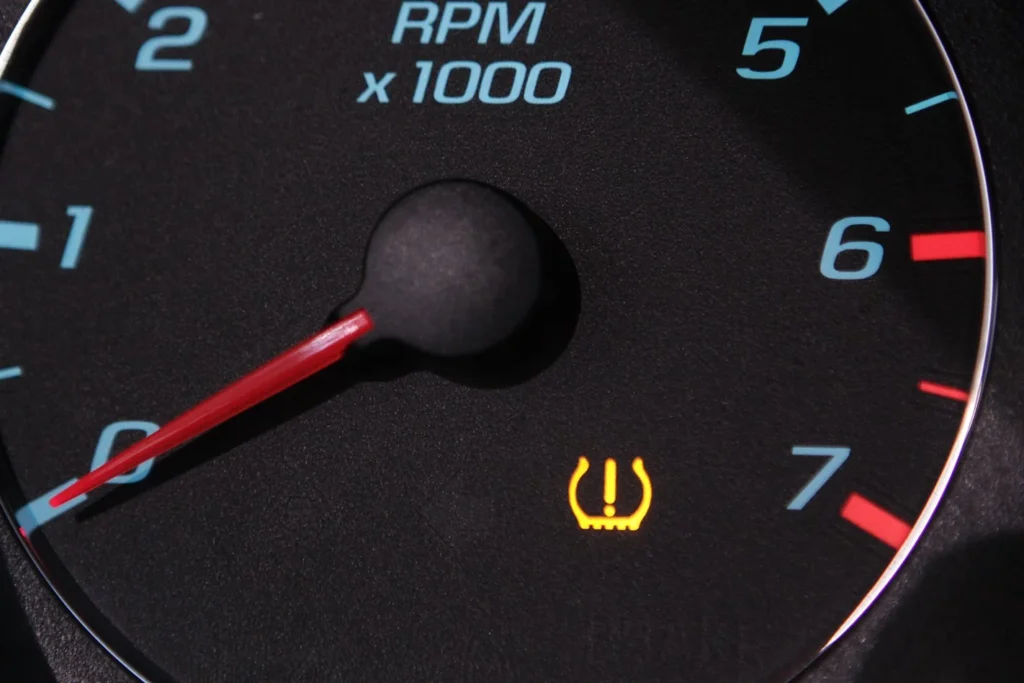
Why Is Your TPMS Light On But Tires Are Fine?
When your TPMS light is on but tires are fine, one of these six causes is almost certainly responsible.
1. Temperature Fluctuations
This is the number one cause of phantom TPMS warnings. Tire pressure changes by approximately 1 PSI for every 10°F shift in ambient temperature. A tire inflated to 35 PSI on a warm afternoon can drop to 31 PSI during a cold overnight — enough to trigger the light.
By the time you check the tires later that morning (after driving and warming them up), the pressure has risen back to normal. The light stays on because the system logged the earlier low reading.
2. TPMS Sensor Battery Failure
Each direct TPMS sensor contains a small lithium battery with a lifespan of roughly 5 to 10 years. When these batteries die, the sensor stops transmitting data entirely. The TPMS module interprets this silence as a fault and illuminates the warning light.
Key sign: The TPMS light flashes for 60–90 seconds when you start the car, then stays on solid. This flashing pattern specifically indicates a system malfunction rather than low pressure.
3. Recently Rotated or Replaced Tires
After a tire rotation, new tire installation, or even a flat repair, the TPMS system may need relearning to recognize which sensor is at which wheel position. Until this relearn procedure is performed, the system may display incorrect readings or keep the light on.
4. Faulty or Damaged TPMS Sensor
Road hazards, pothole impacts, corrosion, and improper tire mounting can damage TPMS sensors. A cracked sensor housing, bent valve stem, or corroded internal components will prevent proper pressure readings — even when your tires are perfectly inflated.
💡 CTA: Curious about sensor replacement pricing for your specific vehicle? Check our [TPMS sensor cost guide by make and model] for accurate estimates.
5. Spare Tire Low Pressure
Here’s a cause most drivers never consider. Many vehicles — particularly trucks and SUVs — monitor the spare tire’s pressure too. If your spare has slowly lost air over months or years of sitting unused, the TPMS light will activate even though all four road tires are fine.
6. System Needs a Manual Reset
Sometimes the TPMS system simply needs a manual reset after you’ve corrected a pressure issue. The system doesn’t always clear itself automatically. Until you perform the proper reset procedure, the light stays on — creating the illusion that something is still wrong.
📸 [Image #2] — Infographic showing 6 causes of false TPMS warnings
How to Fix the TPMS Light When Tire Pressure Is Normal
Follow these proven solutions in order — starting with the simplest fixes first.
Fix 1: Verify All Tire Pressures (Including the Spare)
Don’t trust your eyes or a quick squeeze. Use a calibrated digital tire pressure gauge to check every tire — including the spare.
Inflate each tire to the pressure listed on the driver’s door jamb sticker (not the number on the tire sidewall — that’s the maximum pressure, not the recommended pressure).
Fix 2: Drive for 10–15 Minutes
After inflating all tires to spec, drive at highway speed for 10 to 15 minutes. Many TPMS systems require the vehicle to be driven above 20 mph for the sensors to transmit updated readings and clear the warning automatically.
Fix 3: Perform a TPMS Reset
If driving doesn’t clear the light, perform a manual reset. The method varies by manufacturer:
Common reset methods:
- Reset button method — Press and hold the TPMS reset button (usually under the steering wheel or in the glove box) until the light blinks three times. Release and drive.
- Menu reset — Navigate through your infotainment or instrument cluster menu to Settings → Vehicle → TPMS → Reset/Recalibrate.
- Battery disconnect — Disconnect the negative battery terminal for 10–15 minutes, then reconnect. This forces a full system reinitialization.
Fix 4: Check and Inflate the Spare
If your vehicle monitors the spare tire, locate it and check its pressure. Inflate to the specification listed on the door jamb sticker or spare tire label.
Fix 5: Inspect TPMS Sensors
If the light flashes before staying solid, a sensor has likely failed. You’ll need either a TPMS scan tool or a visit to a tire shop to identify which sensor is malfunctioning.
Fix 6: Have Sensors Relearned After Tire Work
After any tire rotation or replacement, ask the tire shop to perform a TPMS relearn procedure. This tells the system which sensor is now at each wheel position.
📸 [Image #3] — Step-by-step fix process infographic
How to Reset the TPMS Light Step by Step
Since this is the most common fix, here’s a detailed universal reset process that works on most vehicles:
- Inflate all tires (including spare) to the recommended PSI shown on the driver’s door jamb sticker.
- Turn the ignition to “ON” without starting the engine (or press the start button twice without pressing the brake).
- Locate the TPMS reset button — typically found beneath the dashboard near the steering column, inside the glove box, or within the settings menu.
- Press and hold the reset button for 3–5 seconds until the TPMS light blinks three times.
- Start the engine and let it idle for 20 minutes to allow sensors to recalibrate.
- Drive the vehicle at 25+ mph for at least 10 minutes.
- Verify the light remains off after your next engine restart.
No reset button? Some vehicles — particularly Honda, Toyota, and Subaru models — require you to reset through the infotainment system menu or need a dealership scan tool. Check your owner’s manual for model-specific instructions.
📸 [Image #4] — Visual guide showing TPMS reset button locations by brand
TPMS Direct vs. Indirect Systems Explained
Understanding which system your vehicle uses helps you troubleshoot more effectively.
| Feature | Direct TPMS | Indirect TPMS |
|---|---|---|
| How it works | Pressure sensors inside each tire | Uses ABS wheel speed data |
| Accuracy | Highly accurate (exact PSI readings) | Less precise (estimates based on rotation) |
| Sensor replacement needed? | Yes — sensors have batteries | No physical tire sensors |
| Common on | Most US vehicles 2008+ | Some European/Asian models |
| Reset method | TPMS relearn tool or button | Recalibrate through menu/button |
| Cost to repair | $50–$250 per sensor | Usually free (software reset) |
How to tell which system you have: If your dashboard or infotainment screen shows individual tire pressures (e.g., 35, 34, 33, 35), you have a direct system with physical sensors. If it only shows a generic warning with no specific numbers, you likely have an indirect system.
📸 [Image #5] — Comparison graphic of direct vs. indirect TPMS
When to See a Mechanic About Your TPMS Light
While many TPMS issues are DIY-friendly, visit a professional if:
- The light flashes for 60–90 seconds then stays solid (sensor malfunction)
- You’ve replaced the battery or had electrical work done recently
- The light returns immediately after every reset attempt
- Your vehicle is 7+ years old and sensors have never been replaced
- You notice a tire losing pressure repeatedly despite appearing fine (slow puncture)
- You lack the TPMS relearn tool required by your specific vehicle
Average diagnostic fee: $20–$50 at most tire shops. Many offer free TPMS diagnostics when you purchase sensors or tires from them.
TPMS Repair and Replacement Costs
| Service | DIY Cost | Shop Cost |
|---|---|---|
| Tire pressure check and inflate | Free–$5 | Free–$10 |
| TPMS system reset | Free | Free–$50 |
| Single TPMS sensor replacement | $25–$60 | $50–$150 |
| All four sensors replaced | $100–$240 | $200–$600 |
| TPMS relearn procedure | $0 (with tool) | $25–$75 |
| TPMS valve stem rebuild kit | $5–$15 each | $10–$30 each |
| TPMS diagnostic scan | N/A | $0–$50 |
Money-saving tip: When replacing tires, ask the shop to replace TPMS sensor valve stem kits at the same time. These $5–$15 kits include new seals, caps, and cores that prevent corrosion-related failures — saving you a separate service visit later.
📸 [Image #6] — Cost comparison chart
Tips to Prevent False TPMS Warnings
Follow these maintenance habits to minimize phantom alerts:
- Check tire pressure monthly using a quality digital gauge — don’t rely on the TPMS alone.
- Check pressures when tires are cold (before driving or at least 3 hours after stopping) for the most accurate readings.
- Inflate to the door jamb spec, not the tire sidewall number.
- Don’t forget the spare tire — check it every 3–6 months.
- Replace TPMS sensors proactively between 7–10 years of age, or whenever you buy new tires.
- Apply anti-corrosion spray to TPMS valve stems during tire changes, especially in salt belt regions.
- Avoid cheap aftermarket sensors — OEM or quality brands like Schrader, Continental, and Dorman offer better reliability and compatibility.
💡 CTA: Want more tire maintenance tips? Browse our [complete tire care and replacement guide] for expert advice on getting the most life from your tires.
Frequently Asked Questions
Why is my TPMS light on when my tires are properly inflated?
The most common reason is temperature-related pressure fluctuation. Tire pressure drops about 1 PSI for every 10°F decrease in temperature. Other causes include a dead TPMS sensor battery, a low spare tire, needing a system reset after tire work, or a damaged sensor. Check all tires — including the spare — with a calibrated gauge.
How do I reset my TPMS light after filling tires?
Inflate all tires to the recommended PSI on the driver’s door jamb sticker. Then locate the TPMS reset button (usually under the dashboard), press and hold it until the light blinks three times, and drive for 10–15 minutes. Some vehicles reset through the infotainment menu instead. Check your owner’s manual for exact steps.
Can cold weather trigger the TPMS light even with correct pressure?
Yes — this is extremely common. Tires inflated correctly during warm daytime hours can lose enough pressure overnight during cold weather to trigger the TPMS. The light may even turn off later as the tires warm up during driving. Inflating tires 1–2 PSI above the recommendation during winter months helps prevent this.
How long do TPMS sensors last?
TPMS sensor batteries typically last 5 to 10 years, depending on driving conditions, climate, and how frequently the sensors transmit data. Once the battery dies, the entire sensor must be replaced — the battery is sealed inside and cannot be swapped independently. Budget for replacement around the 7-year mark.
Does the TPMS light affect my car’s performance or safety?
The TPMS light itself doesn’t affect engine or drivetrain performance. However, if the light is on because of genuinely low tire pressure (rather than a sensor glitch), driving on underinflated tires reduces fuel economy, accelerates tread wear, and significantly increases blowout risk — especially at highway speeds.
Will disconnecting the battery reset the TPMS light?
Disconnecting the negative battery terminal for 10–15 minutes can reset the TPMS light on many vehicles by clearing stored fault codes. However, if the underlying cause — like a dead sensor or genuinely low pressure — isn’t fixed, the light will return after a few drive cycles.
Can I pass inspection with the TPMS light on?
In most US states that perform vehicle inspections, a continuously illuminated TPMS light will cause a failure. The NHTSA requires a functioning TPMS on all vehicles equipped with the system from the factory. Fix the issue before scheduling your inspection.
How much does it cost to replace a TPMS sensor?
A single TPMS sensor replacement typically costs $50–$150 at a shop, including the sensor, programming, and installation. DIY replacement costs $25–$60 per sensor if you have a TPMS programming tool. Replacing all four sensors during a tire change is the most cost-effective approach.
Final Thoughts
Having the TPMS light on but tires are fine is genuinely one of the most annoying dashboard experiences a driver can face. You know your tires are good. Your gauge confirms it. Yet the light refuses to cooperate.
Now you understand why. In most cases, the fix is refreshingly simple — and often completely free.
Here are the key takeaways to remember:
- Temperature changes are the top cause of phantom TPMS warnings. A cold night can drop pressure enough to trigger the light, even when tires seem fine by morning.
- Always check the spare tire. Many vehicles monitor it, and many drivers forget it exists until it causes a warning.
- TPMS sensor batteries die after 5–10 years. A flashing-then-solid light pattern points directly to sensor failure.
- A simple reset procedure fixes most persistent alerts after you’ve confirmed correct pressure in all tires.
- Budget $50–$150 per sensor if replacement is needed — and consider replacing all four when you buy new tires to save on labor.
The TPMS light on but tires are fine mystery has a logical explanation every single time. Start with the free fixes in this guide, and you’ll solve it quickly without overpaying at a shop.
Have you dealt with a stubborn TPMS light that wouldn’t turn off? What finally fixed it for you? Share your experience in the comments below — your tip might save another driver time and money. And for more trusted repair guides and cost breakdowns, explore CarCostGuide.com.