
You’re driving your Honda Accord on a rainy evening when you glance down and notice an unfamiliar amber triangle with an exclamation point — accompanied by the letters “VSA.” A moment later, you see the familiar check engine light join the party. Your Accord still drives fine, but suddenly you’re worried about safety and repair bills.
The VSA light Honda Accord warning is one of the most frequently reported dashboard alerts among Accord owners across every generation. Honda forums are packed with threads from confused drivers asking the same question: “What does this mean, and do I need to fix it right now?”
The short answer? It depends on the cause. Some triggers are minor sensor glitches that cost nothing to fix. Others point to real safety system failures that need professional attention. In this expert guide from CarCostGuide.com, you’ll learn exactly what activates the VSA warning, how to reset it yourself, and when you genuinely need a mechanic.
💡 Seeing multiple dashboard warnings? Our [complete dashboard warning lights guide] explains every Honda indicator with photos and plain-English descriptions.
What Does the VSA Light Mean on a Honda Accord?
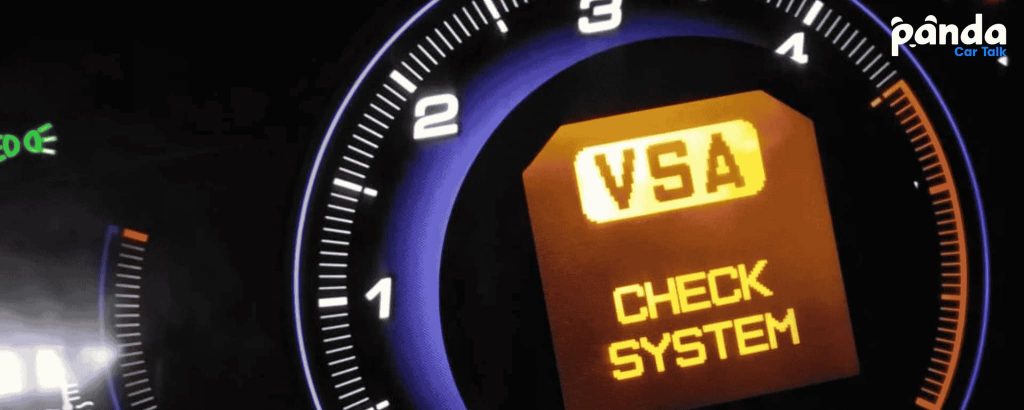
The VSA light indicates a problem with your Honda Accord’s Vehicle Stability Assist system. VSA is Honda’s proprietary electronic stability control technology designed to help you maintain traction and directional control during challenging driving conditions — including wet roads, sudden swerves, and aggressive cornering.
When the VSA system detects an internal fault, it disables itself and illuminates the warning light to let you know the safety net is no longer active. In many cases, the traction control system and sometimes the check engine light activate simultaneously because these systems share sensors and hardware.
| VSA Light Behavior | What It Means | Severity |
|---|---|---|
| VSA light flashing briefly | System actively engaging (normal) | None — working as designed |
| VSA light stays on solid | System fault — VSA disabled | Moderate |
| VSA + check engine light | Shared sensor or engine issue | Moderate to High |
| VSA + ABS light together | Shared component failure | High |
| VSA + triangle exclamation mark | General system malfunction alert | Moderate |
How Honda’s VSA System Works
Understanding the VSA system’s components helps you understand why different problems trigger the same warning light.
Core VSA Components
Honda’s VSA relies on five interconnected systems:
- Wheel speed sensors (four total) — monitor each wheel’s rotational speed
- Steering angle sensor — tracks your steering wheel position
- Yaw rate and lateral G-force sensor — measures rotational movement and side forces
- VSA modulator-control unit — processes data and controls brake pressure
- Engine control module (ECM) — communicates engine torque data to VSA
When the system detects a loss of traction or stability, it automatically reduces engine power and applies individual brakes to specific wheels, guiding your Accord back onto your intended path. This happens in milliseconds — faster than any human could react.
If any single component in this network sends faulty data or stops communicating, the VSA module disables the entire system and displays the warning.
📸 [Image #2] — Diagram showing VSA system components on Honda Accord
7 Common Causes of the VSA Light on Honda Accord
Here are the most frequent triggers for the VSA light Honda Accord warning, based on Honda Technical Service Bulletins, repair shop data, and real owner reports.
1. Faulty Wheel Speed Sensor
Wheel speed sensors are the number one cause of VSA light activation across all Honda Accord model years. These sensors sit at each wheel hub, constantly exposed to road debris, brake dust, water, salt, and extreme temperature swings.
When a sensor fails or becomes contaminated with metallic debris, it sends incorrect speed data. The VSA module interprets this as a potential traction loss and shuts down.
Common DTC codes: 21-1, 23-1, 25-1, 27-1 (Honda-specific codes)
Repair cost: $75–$250 per sensor
2. Defective Steering Angle Sensor
The steering angle sensor sits inside the steering column and tells the VSA system which direction you’re turning. This sensor can lose calibration after a battery disconnect, wheel alignment, or steering repair. When miscalibrated, VSA receives conflicting data and deactivates.
Common trigger events:
- Battery replacement
- Wheel alignment service
- Steering rack or column repair
- Disconnecting electrical connectors near the steering column
3. Engine Misfires or Performance Issues
Here’s one many Accord owners don’t expect. The VSA system monitors engine torque output. When a cylinder misfires, fuel delivery falters, or an ignition coil fails, the resulting torque irregularities trigger the VSA warning — often alongside the check engine light.
Common DTC codes: P0300–P0306 (misfire codes)
This is especially common on 2008–2015 Honda Accord models with the 2.4L four-cylinder engine.
💡 CTA: Want to know the repair costs for your specific Accord year? Browse our [Honda Accord repair cost guide] for model-specific pricing.
4. Failing VSA Modulator-Control Unit
The VSA modulator is the brain and hydraulic heart of the system. Over time — particularly on 2003–2012 Accord models — internal components can develop electrical faults or hydraulic valve sticking. Honda issued several TSBs addressing modulator issues on these generations.
Repair cost: $400–$1,200
5. Low Brake Fluid
The VSA system shares hydraulic components with your Accord’s braking system. When brake fluid drops below the minimum level — often due to worn brake pads extending the caliper pistons — the VSA module detects abnormal hydraulic pressure and activates the warning.
Quick check: Pop the hood, locate the brake fluid reservoir (near the firewall on the driver’s side), and verify the level is between MIN and MAX.
6. Weak or Dead Battery / Voltage Issues
A weak battery or low system voltage wreaks havoc on Honda’s electronic modules. The VSA system is particularly sensitive to voltage drops. A battery that’s nearing the end of its life (3–5 years old) or corroded terminals can cause intermittent VSA warnings.
Real-world pattern: The VSA light appears after a cold start, disappears during driving, and returns the next cold morning.
7. ABS System Malfunction
Since VSA and ABS share the same wheel speed sensors and hydraulic modulator, any ABS fault typically triggers the VSA warning simultaneously. A failing ABS pump motor, corroded ABS wiring, or damaged tone ring will activate both lights.
📸 [Image #3] — Infographic showing all 7 causes with severity indicators
Is It Safe to Drive With the VSA Light On?
Your Accord will still drive normally in most situations. Your standard brakes, power steering, and engine continue to function. However, you’ve lost your electronic stability and traction control safety systems.
Here’s what you’re driving without:
- Electronic stability control — prevents loss of control during emergency maneuvers
- Traction control — prevents wheel spin on slippery surfaces
- Advanced ABS integration — optimized braking performance in curves and during lane changes
According to the NHTSA, electronic stability control reduces fatal single-vehicle crashes by 56% and fatal rollovers by 80%.
| Driving Condition | Risk Without VSA |
|---|---|
| Dry roads, normal driving | Low |
| Wet or rainy roads | Moderate to High |
| Snow, ice, or gravel | High |
| Emergency swerving | Very High |
| Mountain/curvy roads | Moderate to High |
Practical advice: You can drive carefully to a repair shop. However, avoid aggressive driving, high-speed highway travel in bad weather, and emergency-level maneuvers until the system is repaired.
⚠️ If the ABS light is also on, your anti-lock braking system may also be disabled. This is a more serious safety concern — schedule service as soon as possible.
How to Reset the VSA Light on Honda Accord
After identifying and fixing the root cause, use one of these methods to reset the warning.
Method 1: VSA Button Reset
- Start the engine and let it idle.
- Locate the VSA button — typically on the dashboard to the left of the steering wheel.
- Press and hold the VSA button for approximately 5 seconds.
- The VSA light should turn off. If the “VSA OFF” indicator illuminates, press the button once more briefly.
- Drive for 5–10 minutes to confirm the light stays off.
Method 2: Steering Angle Sensor Recalibration
If the VSA light appeared after a battery replacement, alignment, or steering work:
- Start the engine.
- Turn the steering wheel all the way to the left until it stops.
- Turn the steering wheel all the way to the right until it stops.
- Return the wheel to dead center.
- Turn off the engine, wait 10 seconds, and restart.
- Drive in a straight line for 1–2 minutes above 20 mph.
This procedure allows the steering angle sensor to recalibrate itself on many Honda Accord model years.
Method 3: Battery Disconnect Reset
- Turn off the engine.
- Disconnect the negative (−) battery terminal.
- Wait 15–20 minutes.
- Reconnect the terminal firmly.
- Start the engine and drive normally for 10–15 minutes.
Method 4: Professional Scanner Reset
If the above methods don’t work, the VSA module has stored hard fault codes that require clearing with a Honda-compatible diagnostic scanner. Tools like the Honda HDS (dealer tool), iCarsoft i990, or Foxwell NT510 can access Honda’s proprietary VSA module.
📸 [Image #4] — Step-by-step VSA reset methods infographic
Important: Only reset the VSA light after repairing the underlying problem. Clearing codes without fixing the fault guarantees the light will return.
How to Diagnose VSA System Problems
Follow these steps to identify what’s actually wrong before spending money on repairs.
Step 1: Check for Obvious Issues First
- Brake fluid level — is it between MIN and MAX?
- Battery health — is the battery more than 3 years old? Are terminals corroded?
- Recent service work — did you recently have an alignment, battery replacement, or brake service?
- VSA button — did someone accidentally press it, activating “VSA OFF”?
Step 2: Scan for Diagnostic Codes
Honda uses a combination of standard OBD-II codes and Honda-specific DTC codes for the VSA system. You’ll need a scanner capable of reading ABS/VSA modules — a basic engine-only scanner won’t access these.
Recommended scanners for Honda:
- iCarsoft i990 (~$120) — reads Honda ABS/VSA codes
- Foxwell NT510 Elite (~$160) — deep Honda coverage
- BlueDriver (~$100) — reads enhanced Honda codes via smartphone
Step 3: Inspect Wheel Speed Sensors
Safely raise the vehicle and visually inspect each wheel speed sensor for:
- Physical cracks or damage
- Metallic debris stuck to the sensor tip
- Corroded or disconnected wiring connectors
- Damaged tone rings (reluctor rings)
Step 4: Check for Honda TSBs
Honda has released multiple Technical Service Bulletins addressing VSA problems on specific Accord generations. Search the NHTSA recall and TSB database using your VIN for relevant bulletins.
💡 CTA: Need accurate repair quotes before visiting a mechanic? Use our [Honda repair cost estimator] for instant pricing by model year.
📸 [Image #5] — VSA diagnostic flowchart
VSA Light Repair Costs
| Problem | DIY Cost | Mechanic Cost |
|---|---|---|
| VSA button reset | Free | Free–$25 |
| Steering angle sensor calibration | Free (DIY method) | $50–$150 |
| Battery terminal cleaning | $5–$10 | $20–$50 |
| Battery replacement | $80–$200 | $120–$300 |
| Brake fluid top-off | $5–$15 | $20–$50 |
| Wheel speed sensor replacement | $25–$80 each | $100–$300 |
| ABS/VSA sensor wiring repair | $10–$30 | $75–$200 |
| Spark plug/ignition coil replacement | $50–$150 | $150–$400 |
| VSA modulator-control unit | $300–$800 | $500–$1,200 |
| Full VSA diagnostic scan | Free–$100 | $50–$150 |
Money-saving tip: Before authorizing expensive modulator or sensor replacements, always check the brake fluid level and battery voltage first. These two free checks resolve a surprising percentage of VSA light cases.
📸 [Image #6] — Cost comparison chart
How to Prevent VSA Light Problems
These proactive habits minimize your chances of encountering the VSA light Honda Accord warning:
- Check brake fluid every 3–6 months. Low fluid is the easiest preventable trigger.
- Flush brake fluid every 3 years. Honda specifically recommends this interval. Old fluid absorbs moisture and corrodes ABS/VSA components internally.
- Replace your battery every 4–5 years. A weak battery causes voltage-related VSA faults. Test it annually after year three.
- Clean battery terminals regularly. Corrosion creates resistance that starves electronic modules.
- Inspect wheel speed sensors during brake jobs. Clean debris from sensor tips and check wiring at every pad or rotor change.
- Recalibrate the steering angle sensor after every alignment, tire replacement, or steering system service.
- Replace spark plugs on schedule. Honda recommends every 60,000–105,000 miles depending on the engine. Misfires trigger VSA warnings.
- Don’t ignore intermittent warnings. A VSA light that appears and disappears signals a worsening problem — not a resolved one.
Frequently Asked Questions
What does the VSA light mean on a Honda Accord?
The VSA light on a Honda Accord indicates a fault in the Vehicle Stability Assist system. VSA is Honda’s electronic stability and traction control technology. When the light stays on, the system has detected a problem — such as a faulty wheel speed sensor, low brake fluid, or engine misfire — and has disabled itself. Your standard brakes still work normally.
Can I drive my Honda Accord with the VSA light on?
Yes, but with caution. Your Accord’s standard brakes, steering, and engine continue to function normally. However, you’ve lost electronic stability control and traction control — critical safety systems for wet roads, emergency maneuvers, and slippery conditions. Drive carefully and schedule service soon.
How do I reset the VSA light on my Honda Accord?
Try pressing and holding the VSA button (left of the steering wheel) for 5 seconds with the engine running. If that doesn’t work, perform a steering angle sensor recalibration by turning the wheel fully left, fully right, and back to center. You can also disconnect the negative battery terminal for 15–20 minutes. Always fix the root cause before resetting.
Why do the VSA and check engine light come on together?
The VSA system monitors engine performance data through the Engine Control Module. When a problem like an engine misfire, faulty oxygen sensor, or throttle body issue triggers the check engine light, it simultaneously disrupts the torque data VSA relies on — causing both lights to activate. Fixing the engine issue typically resolves both warnings.
Is the VSA system the same as traction control?
Not exactly, but they’re closely related. Traction control specifically prevents wheel spin during acceleration. VSA is a more comprehensive system that includes traction control plus electronic stability control — which prevents skidding, oversteering, and understeering during cornering and emergency maneuvers. VSA is the broader system; traction control is one function within it.
Can a weak battery cause the VSA light on a Honda Accord?
Absolutely. Honda’s electronic modules — including the VSA system — are highly sensitive to voltage fluctuations. A battery with declining capacity can’t maintain stable voltage during high electrical demand (starting, headlights, blower motor), causing the VSA module to register faults. Replacing an aging battery often resolves persistent or intermittent VSA warnings.
Does the VSA light affect my Honda Accord’s fuel economy?
Not directly. The VSA system operates passively during normal driving and only intervenes during traction or stability events. However, if the VSA light was triggered by an engine misfire or sensor fault that also affects fuel delivery, you may notice reduced fuel economy from the underlying engine problem — not from the VSA system itself.
How much does it cost to fix the VSA system on a Honda Accord?
Repair costs range from free (button reset or brake fluid top-off) to $1,200 (modulator unit replacement). The most common fixes — wheel speed sensors, battery replacement, and brake fluid — typically cost between $50 and $300. Getting a proper diagnostic scan identifies the exact cause so you avoid paying for unnecessary repairs.
Final Thoughts
The VSA light Honda Accord warning feels alarming — but understanding it transforms anxiety into confidence. In most cases, the cause traces back to an affordable, straightforward repair: a dirty wheel speed sensor, a low brake fluid level, or a battery that’s seen better days.
Key takeaways to remember:
- VSA is Honda’s electronic stability and traction control system — when the light stays on, these safety features are disabled.
- Wheel speed sensors are the most common cause of VSA warnings and typically cost $100–$300 to replace.
- Low brake fluid and weak batteries are the two easiest causes to check and fix — often for under $50.
- Engine misfires frequently trigger the VSA light alongside the check engine light. Fix the engine issue and both warnings usually clear.
- Always fix the root cause before resetting the warning. Clearing codes without repairing the problem guarantees the light returns.
The VSA light Honda Accord warning is your car’s way of telling you a safety system needs attention. Respond promptly, diagnose correctly, and you’ll get back to driving with full confidence — and full protection.
What triggered the VSA light on your Honda Accord? How did you fix it? Share your experience in the comments — your solution could help another Accord owner avoid an expensive repair. For more Honda repair guides and cost breakdowns, visit CarCostGuide.com.